
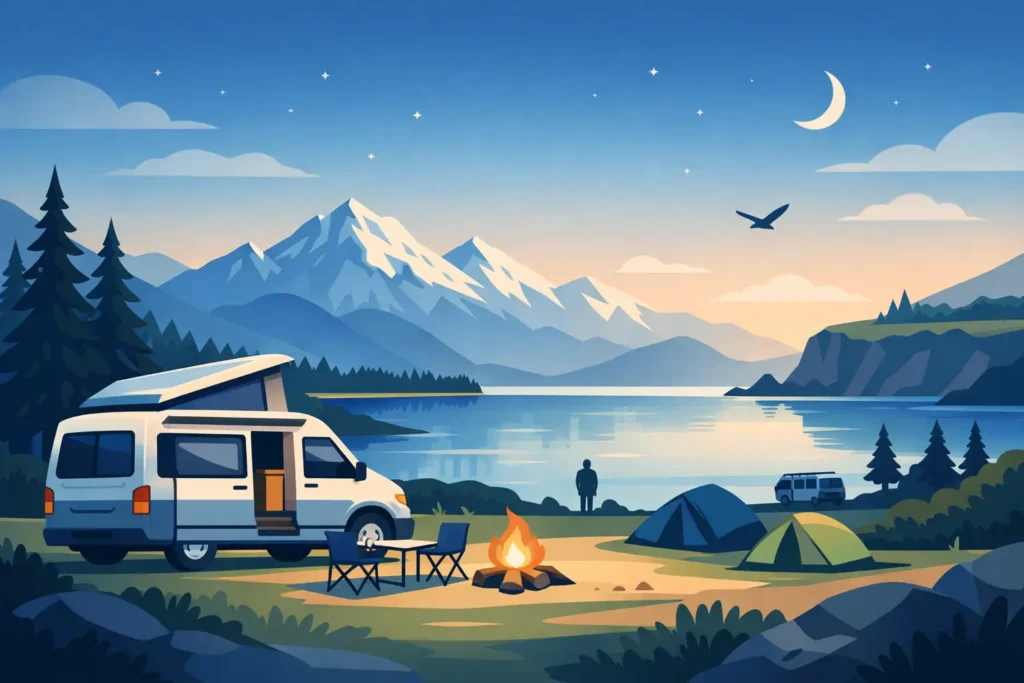
Pulling in late, making dinner in the van, and getting a solid night’s sleep sounds simple until you hit the first sign that says no overnight parking. That’s why one of the first questions travelers ask is where can campervans park overnight in New Zealand. The short answer is that you usually have a few options, but the right one depends on your van, the local council rules, and how much certainty you want at the end of the day.
If you’re road tripping the South Island, it pays to sort this out before you’re tired, low on phone battery, and trying to read tiny signs in the dark. New Zealand is camper-friendly, but it is not a free-for-all. Some places welcome overnight vans. Others allow it only in marked areas. Plenty do not allow it at all.
Where can campervans park overnight?
Most campervans in New Zealand park overnight in one of four places: holiday parks, Department of Conservation campgrounds, designated freedom camping areas, or private land with permission. Those are the real categories that matter on the road. Everything else, like supermarket parking lots, scenic pull-offs, or random side streets, is usually a maybe at best and illegal at worst.
The easiest option is a paid campground. It costs more, but you know what you’re getting. You’ll usually have bathrooms, showers, kitchen space, and no stress about being moved on. After a long driving day, that certainty can be worth more than saving a few dollars.
DOC campgrounds are a good middle ground. They’re often in excellent locations and usually cheaper than holiday parks, but facilities vary a lot. Some are basic and some are very basic. You might get toilets and little else. If that suits your style, they’re one of the best ways to stay close to beaches, mountains, and trailheads without overcomplicating the trip.
Freedom camping is what most people mean when they ask where can campervans park overnight for free. This can be a great option, but only when it’s clearly allowed. Different councils have different rules, and some sites are restricted to self-contained vehicles only. Others have night limits, vehicle number limits, or seasonal restrictions.
Private land is the simplest rule of all. If the owner says yes, you’re good. That might be a farm stay, a driveway, or a spot arranged directly with a host. It’s less spontaneous, but often quieter and more straightforward than hunting for a legal public site.
The rule that catches travelers out
The biggest mistake people make is assuming a self-contained van can park anywhere overnight. It can’t. Self-containment helps, and in many areas it is required, but it does not override local restrictions. If a council says no overnight camping in that area, then it’s still a no.
The second mistake is confusing parking with camping. You may be allowed to park somewhere during the day but not sleep there overnight. That applies to town centers, beach car parks, and roadside rest areas more often than travelers expect.
Signs matter. Marked bays matter. Time limits matter. If a location says no camping between certain hours, or only in designated spaces, take that literally. New Zealand councils do issue fines, and locals are understandably protective of places that get overused.
Paid campgrounds are the low-stress choice
If your priority is a smooth trip, paid campgrounds make life easier. Holiday parks are common across the South Island, especially near major routes and popular towns. They’re ideal when you want showers, power, laundry, or a break from managing everything yourself.
They’re also useful on the first and last nights of a trip. After a flight into Christchurch or before returning a van near Queenstown, a campground can take the pressure off. You don’t need to spend the evening figuring out whether a freedom camping area is full or legal for your setup.
The trade-off is cost and atmosphere. Some holiday parks are friendly and relaxed. Others feel a bit more structured and busy, especially in peak season. If you want wilderness, they may not be your favorite nights. But if you want predictability, they do the job well.
DOC sites work well if you like simple travel
Department of Conservation campgrounds suit travelers who are happy with fewer extras and better scenery. They’re often in memorable places and usually feel more connected to the landscape than commercial campgrounds.
The catch is that you need to arrive prepared. Not every site has showers. Some have drop toilets, untreated water, or limited spaces. A compact campervan setup tends to work well here because you’re already traveling simply. If your expectation is a practical overnight base rather than a resort, DOC sites can be one of the best parts of the trip.
During summer and around holidays, popular DOC campgrounds fill up quickly. Some can be booked, while others are first come, first served. That means timing matters. If you’re aiming for a well-known lake or coastal area, don’t assume there will be space late in the evening.
Freedom camping works, but only when you do it properly
Freedom camping gets a lot of attention because it can keep costs down and give you more flexibility. Done right, it’s a solid option. Done casually, it’s how people end up with fines, awkward late-night moves, or bad experiences with locals.
Before stopping for the night, check whether freedom camping is allowed in that district and whether the exact site is designated for overnight stays. Some councils publish maps and rules, and camping apps can help, but don’t trust old reviews over current signage on the ground.
You also need to think practically. A legal site next to a highway may still be a poor night’s sleep. A scenic pull-off may be exposed to weather. A popular lakefront area may turn noisy once a few more vans roll in. Free is not always better if it leaves you tired the next morning.
This is where discreet, easy-to-park vans have a real advantage. A compact camper is simpler to place in marked spaces and less stressful to maneuver in small towns and crowded lots. That matters more than people think when you’re arriving near dusk.
How to choose the right overnight spot each day
The best approach is not to decide between free camping and paid camping for the whole trip. Mix both based on the day. If you’ve had a long drive, bad weather, or need showers and laundry, book a campground. If you’ve got an early hike planned and there’s a legal DOC or freedom camping site nearby, that might be the better call.
Think about your evenings honestly. If you want to cook, charge devices, reorganize gear, and sleep well, choose a place that supports that. If you just need a simple legal place to stop and head out early, basic sites make more sense.
It also helps to make the call before 5 pm when possible. Waiting until dark limits your options and increases the chance of settling for somewhere you’re unsure about. Road trips feel flexible when you stay slightly ahead of the day, not when you’re scrambling at the end of it.
A few South Island realities worth knowing
The South Island is spacious, but that does not mean every beautiful place allows overnight parking. Tourist hotspots often have tighter rules because demand is high. Queenstown, Wanaka, Tekapo, and other popular areas can be especially strict or heavily monitored.
Weather also changes the equation. A remote lakeside site can feel perfect in calm conditions and miserable in wind or rain. In colder months, having access to proper facilities matters more. In peak summer, site availability becomes the bigger issue.
Mobile signal is another practical factor. If you rely on an app to find legal spots, don’t wait until you’re deep into a remote area to check. Save options earlier in the day. A little planning goes a long way.
For travelers renting a simple self-built van, this style of trip tends to work best when you keep things realistic. You do not need a massive motorhome or a rigid itinerary. You just need a van that’s easy to live with, a basic understanding of local rules, and a habit of choosing legal stops before you’re exhausted. That’s the kind of travel Kim Campers is built around – simple, practical, and road-tested.
A good overnight spot is not always the cheapest or the most dramatic one on the map. It’s the one where you can park legally, sleep properly, and wake up ready to keep going.