
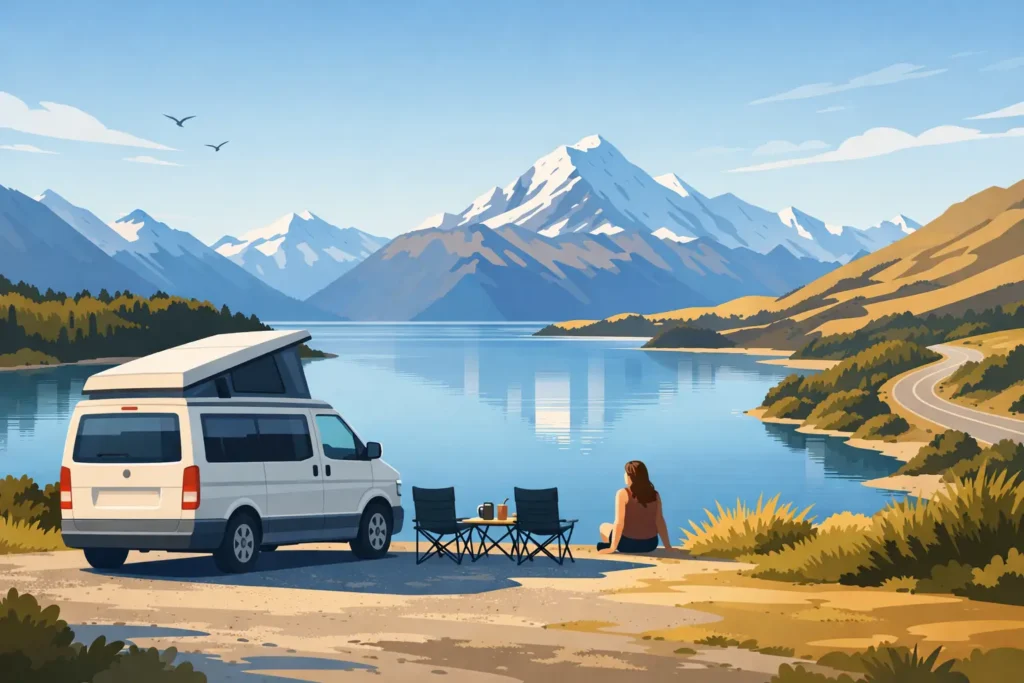
A South Island road trip looks simple on a map. Then you realize one short-looking stretch includes a mountain pass, a lake you want to stop beside, a bakery worth pulling over for, and a weather change that makes you rethink the whole afternoon. That is the point of vanlife travel here: you are not trying to tick off every place. You are giving yourself enough room to follow the road when it gets interesting.
A campervan gives you that flexibility, but it also asks you to travel with a little more awareness. Where will you sleep? How far do you actually want to drive? What happens if rain settles in for two days? The best trips are rarely the ones with the busiest itinerary. They are the ones with a workable plan, a reliable van, and enough spare time to change it.
Why vanlife travel works in the South Island
The South Island is built for independent travel. Christchurch is an easy place to begin, with coastal roads, alpine towns, and the Mackenzie Country all within reach. Queenstown puts you close to Central Otago, Fiordland, and the Southern Lakes. Between them are enough quiet detours to fill weeks, not days.
A compact campervan makes the trip feel less staged. You can cook breakfast near a lake, take a long walk without rushing back to a hotel, and move on when a town feels too busy. It is also more practical than a large motorhome on narrow roads, small parking areas, and the winding routes that lead to the good stuff.
That does not mean every day should be unplanned. South Island distances can be deceptive. A 150-mile drive may take much longer than expected once you factor in one-lane bridges, photo stops, roadworks, weather, and the fact that mountain roads are not the place to hurry. Plan fewer miles than you think you can cover. You will enjoy the trip more for it.
Build a route with breathing room
A strong route has a direction, not a minute-by-minute schedule. If you are starting in Christchurch, a classic loop might take you through Lake Tekapo and Aoraki Mount Cook, down to Wanaka and Queenstown, then west to Te Anau or up through the West Coast before returning via Arthur’s Pass. But the best version depends on your season and how much time you have.
With a week, pick two or three regions and stay longer in each. Trying to drive Christchurch to Queenstown, Milford Sound, the West Coast, and back in seven days can turn a road trip into a long series of windshield views. Two weeks gives you more room for the West Coast, hiking days, slow mornings, and weather changes. Three weeks lets you travel at a pace that feels more like living on the road than racing through it.
Give each driving day an anchor. It might be a campground near a trailhead, a booked activity, or simply a town where you plan to restock groceries. Then leave the rest open. If the forecast is clear around Aoraki Mount Cook, go there. If rain is hitting the mountains, shift toward a museum, a hot pool, a café town, or a lower-elevation walk.
Let weather make some decisions
South Island weather is part of the trip, not a minor detail. Conditions can change quickly around the mountains, and the West Coast gets far more rain than Central Otago. Summer brings longer days and more demand for popular campgrounds. Winter can be beautiful and quiet, but snow, ice, and shorter daylight hours require more care.
Check the forecast each morning and treat it as a guide rather than a guarantee. Keep a flexible day or two in your itinerary, especially if hiking, stargazing, or mountain views are high on your list. A clear day is worth moving for.
Choose a campervan that suits the trip
For most couples, bigger is not automatically better. A huge vehicle can offer more interior space, but it can also be harder to park, more expensive to fuel, and less comfortable on tight roads. A compact van is often the better trade-off when your days involve moving between trailheads, lakeside towns, grocery stores, and small campgrounds.
What matters is whether the layout works in real life. You need a proper bed, basic cooking equipment, practical storage, charging options, and enough room to organize your gear without pulling everything outside every morning. The van should feel simple to operate after the first few minutes, not like a small apartment with a manual.
Kim Campers is built around that idea: straightforward, self-built campervans made for real South Island road trips rather than oversized holiday setups. The goal is not to load you up with features you will barely use. It is to give you a comfortable, discreet, road-ready base for the places you came to see.
Before you set off, take time at pickup to understand the sleeping setup, cooking gear, power, water, and any self-containment requirements. Ask questions early. A few clear answers at the start make the rest of the trip easier.
Overnight stays: freedom with responsibility
Sleeping in a campervan does not mean parking anywhere that looks scenic. New Zealand has specific rules around freedom camping, and they vary by location. Some areas allow self-contained vehicles only. Others prohibit overnight stays altogether. Campgrounds may be basic or fully equipped, and popular places can fill up during peak season.
Use designated campgrounds when you want showers, laundry, a communal kitchen, or a dependable place to recharge. They are also a good choice when bad weather makes a simple night in the van feel less appealing. Freedom camping can be a great option where it is permitted, but always check local signs and rules before settling in.
The practical standard is simple: leave no trace, use toilets and waste facilities properly, keep noise down, and do not treat a public parking area like a private campsite. The places that make vanlife travel special stay special when travelers respect them.
Pack for small-space living, not just photos
Packing light matters more in a campervan than in a hotel room. Every extra item needs a place to live, and clutter gets old fast when rain keeps you inside. Bring layers instead of bulky single-purpose outfits. Even in summer, mornings and evenings can be cold near the mountains.
A good road-trip setup includes a waterproof jacket, warm midlayer, comfortable walking shoes, swimwear, a reusable water bottle, sunscreen, insect repellent, and a small daypack. Add a headlamp for campgrounds, a power bank for long days away from the van, and a simple clothesline if you are traveling for more than a week.
Buy groceries in larger towns, then top up as you go. Small communities can have limited choices and higher prices, especially in remote areas. Keep easy meals on hand for late arrivals: pasta, rice, eggs, soup, wraps, fruit, coffee, and something you can cook when the weather makes going out feel unnecessary.
Drive like the road deserves your attention
If you are visiting from the United States, remember that New Zealand drives on the left. Give yourself time to adjust, especially at roundabouts and when turning onto an open road. The first hour may feel unfamiliar. After a day or two, it usually becomes natural.
Do not underestimate gravel roads, blind corners, or single-lane bridges. Pull over when safe if faster local traffic catches up behind you. Keep your eyes on the road rather than trying to film every view from the driver’s seat. There will be another lookout soon enough.
Fuel up before remote sections, keep water in the van, and avoid driving tired. The South Island rewards slow travel. A short driving day with a long walk, a swim, or an unplanned stop beside a lake will usually stay with you longer than another 200 miles.
The best road-trip days often begin without much drama: coffee made in the van, a quick check of the forecast, and one good place to aim for. Leave enough space for the unexpected turnoff. In the South Island, that is often where the day gets good.