
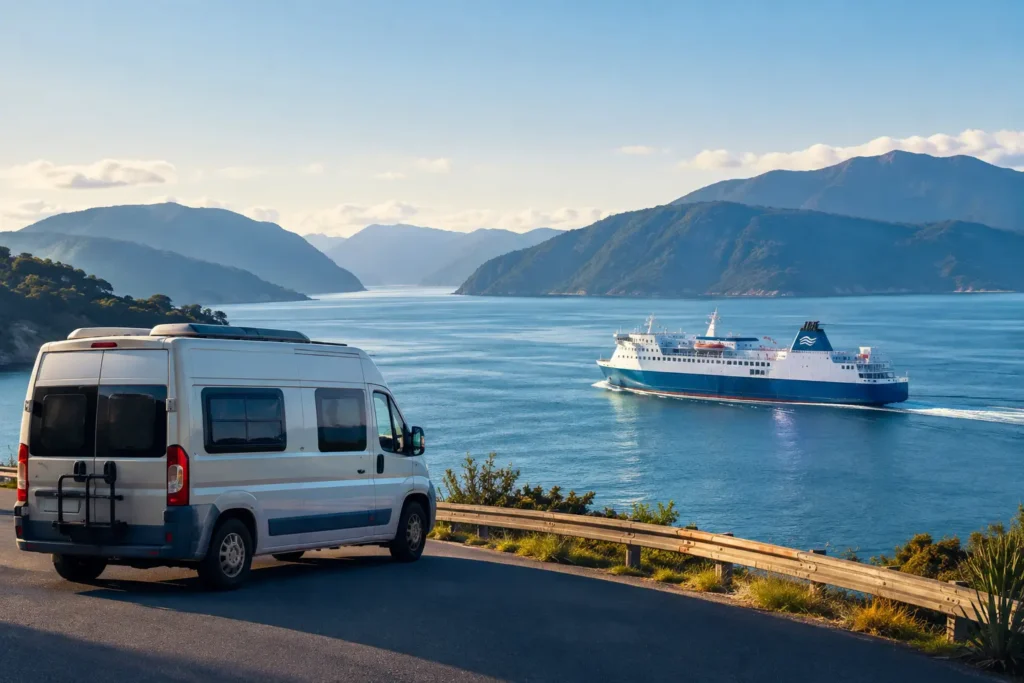
A South Island road trip can turn into a North Island trip without giving up your campervan. Can campervans cross Cook Strait? Yes. They travel as vehicles on the Cook Strait ferry, while you travel upstairs as a foot passenger with a very convenient place to sleep waiting at the other end.
It is a straightforward crossing, but it is not something to leave until the day before. Ferry spaces for vehicles are limited, summer sailings fill up, and a campervan booking has different requirements from a booking for a regular car. Get the details right early and the ferry becomes a useful break in the drive, not the stressful part of your trip.
Can campervans cross Cook Strait on any ferry?
Campervans can cross Cook Strait on the vehicle ferries that run between Picton in the South Island and Wellington in the North Island. The main operators carry cars, vans, motorhomes, motorcycles, freight, and walk-on passengers. Your van drives aboard via the vehicle deck, is secured for the sailing, and is unloaded at the other end.
The trip usually takes around three and a half hours. Much of that time is spent in the sheltered Marlborough Sounds, which is a genuinely scenic stretch of the journey. The open-water section of Cook Strait can be rough when the weather is up, though, so do not treat the sailing as a guaranteed calm cruise.
You cannot stay in your campervan while the ferry is moving. Once parked, you will need to take your day bag upstairs with you. Pack food, layers, medication, chargers, and anything else you might want during the crossing before joining the vehicle queue. Access to the vehicle deck is normally restricted after departure.
Book the campervan, not just a passenger ticket
This is the part that catches people out. When booking, choose a vehicle fare and enter the campervan’s correct length, height, and registration details if requested. A compact van may be easier to fit into the booking system than a large motorhome, but accuracy still matters. Ferry operators assign deck space based on the dimensions you provide.
Measure or confirm the vehicle dimensions from your rental documents rather than guessing. Roof vents, awnings, roof boxes, bike racks, and other additions can affect the overall height or length. If the van is longer than declared, the operator may need to move you to another sailing or charge the difference if space is available.
You will also book each person traveling with you. Vehicle fares and passenger fares are generally separate, so compare sailing times rather than assuming the first headline price is your total. Prices change with demand, vehicle size, flexibility, and how far ahead you book.
For peak travel periods, reserve as soon as your route is reasonably fixed. December through March, school vacation periods, long weekends, and popular one-way road-trip dates are the times when campervan spaces disappear first. A flexible fare can cost more, but it may be worth it if your plan depends on weather, a hike, or a flight connection.
Check your rental agreement before paying
A rental campervan is not automatically approved for inter-island travel. Some companies allow Cook Strait crossings but require advance notice. Others limit their fleet to one island, charge a relocation fee, or arrange a vehicle swap rather than putting a van on the ferry.
Read the agreement and ask the owner directly if the wording is unclear. Confirm whether ferry travel is permitted, whether you must book it yourself, and what happens if a sailing is delayed or canceled. It is much easier to sort this out before you have built an itinerary around Wellington or Auckland.
If your trip is focused on the South Island, you may not need the ferry at all. Picking up in Christchurch gives you access to mountains, lakes, coastlines, and plenty of quiet overnight stops without spending a day crossing the strait. For travelers who want both islands, however, taking the van with you keeps the road trip simple and avoids repacking into a different vehicle.
What ferry day actually looks like
Plan to arrive at the vehicle terminal well before departure. Your confirmation will state the required check-in time, and vehicle check-in commonly closes earlier than passenger check-in. In busy periods, allow extra time for traffic around the terminal, fuel stops, returning rental gear, and finding the correct lane.
Staff will direct you into a line with other vehicles. Keep your booking confirmation and photo ID handy. When boarding begins, follow the crew’s instructions slowly and exactly. Ferry decks can be tight, ramps can be steep, and you may be parked close to other vehicles. This is normal, even if it feels a little dramatic the first time.
Before leaving the van, engage the parking brake, lock it, and take your essentials upstairs. Do not leave loose items on the dashboard or in open shelves. A well-packed campervan is more pleasant to return to after a bumpy crossing.
At arrival, passengers are called back to the vehicle deck. Wait for the crew’s signal, start up when instructed, and drive off at a slow pace. In Picton, you are moments from the Marlborough Sounds and the road south. In Wellington, give yourself time to get used to city traffic before heading farther north.
Weather, delays, and the reality of Cook Strait
Cook Strait has a reputation for a reason. Wind and swell can make some crossings uncomfortable, and severe weather can delay or cancel sailings. Mechanical issues and operational changes can also affect schedules. Most crossings run without much drama, but a smart itinerary leaves room for the occasional curveball.
Do not book a nonrefundable flight, a major event, or a same-day vehicle return immediately after a ferry arrival if you can avoid it. An overnight buffer is especially sensible when you are traveling in winter or during a period of unsettled weather. If you have a morning sailing, consider staying nearby the night before rather than relying on a long drive to the terminal.
For motion sickness, sit where you can see the horizon, avoid reading during rough conditions, and bring any medication that works for you. Fresh air on an outside deck can help, but pack a warm layer. The wind through the strait is often colder than travelers expect, even on a bright day.
Fuel, gas, and campervan basics
Arrive with enough fuel to continue after disembarking. You do not need a full tank for the sailing itself, but it is useful not to begin your next island with a fuel hunt, particularly if you arrive late. Check where the nearest fuel stations are before departure.
If your campervan has a portable gas canister or other potentially hazardous item, follow the ferry operator’s current rules and declare anything they require. Rules can vary by product and operator. Do not assume that because an item is normal camping gear, it needs no mention at check-in.
The same applies to lithium batteries, e-bikes, and larger outdoor equipment. Bring the equipment you need for the trip, but know what is onboard and store it sensibly. A compact, practical setup is an advantage here: fewer bulky extras means less to manage at every handover, ferry terminal, and campsite.
Is taking a campervan across worth it?
It depends on how much time you have. If you have two weeks or more and want a proper taste of both islands, taking your campervan across is often the best option. You keep your sleeping setup, food, and gear with you, and you avoid losing a day to a vehicle exchange.
For a shorter trip, one island can be the better choice. The South Island alone can easily fill ten days with a route from Christchurch to Lake Tekapo, Aoraki Mount Cook, Wānaka, Queenstown, the West Coast, and Nelson or Kaikōura. Trying to cover both islands in a week usually means more driving and fewer days where you can stop because the view looks good.
The ferry cost is also a real part of the budget. A van crossing is more expensive than taking yourself across as a walk-on passenger, and prices can rise sharply at busy times. Still, when you factor in accommodation, transport, and the convenience of keeping your own road-trip base, it can make good sense for couples and independent travelers.
A better way to plan the crossing
Build your route around the sailing rather than squeezing the sailing into an already packed day. Book the van with its true dimensions, confirm that your rental allows the crossing, arrive early, and leave a little breathing room at both ends. Then treat the trip through the Sounds as part of the adventure, not dead time between destinations.
The best Cook Strait crossing is the one that leaves you free to roll off the ferry, make a coffee somewhere with a view, and keep following the road without needing to rush.