
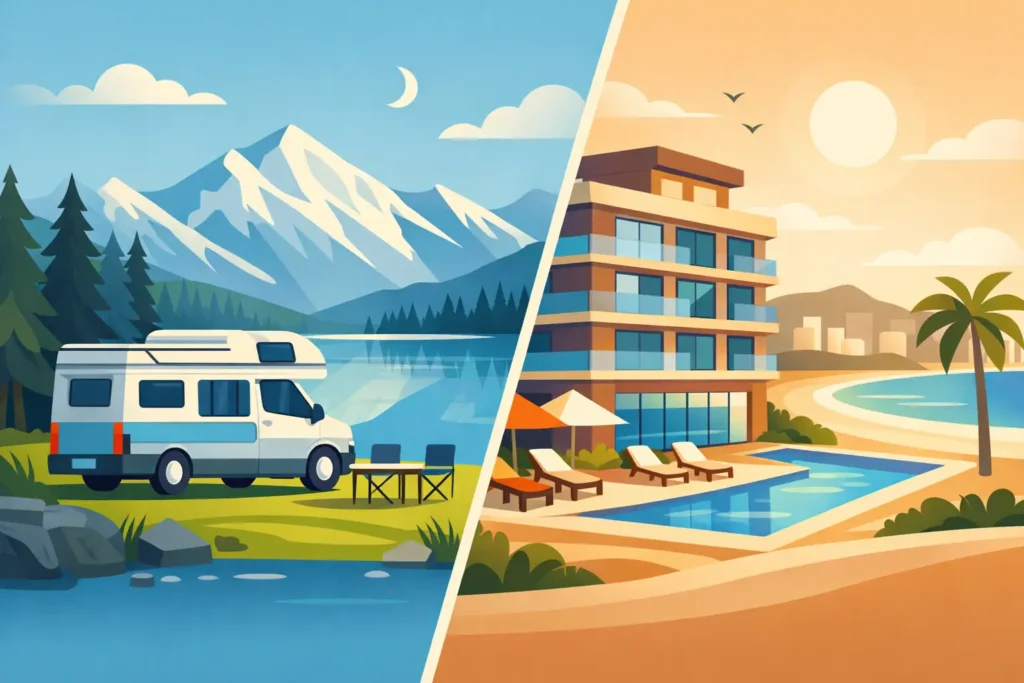
A South Island trip can look very different depending on where you sleep. Campervan versus hotel accommodation is not simply a question of budget. It decides whether you follow a fixed itinerary, linger at a quiet lake, or spend an extra morning in a place that turns out to be better than expected.
Hotels make sense for some trips. A campervan makes sense for others. The right choice comes down to how you want to move through New Zealand, how much comfort you need at the end of the day, and whether flexibility is worth more to you than a room with four walls.
Campervan versus hotel accommodation: the real difference
A hotel trip is built around destinations. You book a room in Christchurch, Lake Tekapo, Queenstown, or Wanaka, then drive between them according to check-in times and your reservation calendar. That can be easy and comfortable, especially if you are only visiting for a few nights or want to stay in the middle of town.
A campervan trip is built around the road between those destinations. Your bed, kitchen basics, and everyday gear travel with you. You still need to plan campsites and follow local rules, but you are not repacking every morning or checking whether the next town has a room available.
For independent travelers, that difference matters. The South Island rewards people who can adjust their plans. Weather changes quickly around Aoraki Mount Cook, mountain passes can be slow, and a short drive on a map can become a full day once you stop for walks, viewpoints, and a swim in a clear river.
Neither option is automatically better. A couple taking a relaxed two-week road trip may get more from a campervan. Someone arriving late, leaving early, and spending most of their time in Christchurch or Queenstown may prefer a hotel room.
Cost: compare the whole trip, not the nightly rate
Hotel prices are easy to understand at first glance. You see a nightly room rate and know what you are getting: a private room, bathroom, bed, and often a central location. But a South Island hotel itinerary usually comes with extra costs. You may need a rental car, restaurant meals, parking, and different accommodation bookings every few nights.
With a campervan, the daily rental price is only one part of the picture too. Add fuel, campground fees, food, and any activity costs. The difference is that a compact campervan combines transportation and sleeping space, while also giving you the option to prepare simple meals rather than eating out three times a day.
This does not mean campervan travel is always cheaper. During peak summer, popular holiday parks can add up, particularly when you want powered sites and full facilities. Hotels can also be good value during quieter periods, or when a special deal includes breakfast and parking. Still, for a multi-day trip, the ability to cook breakfast, make coffee, and carry lunch often takes real pressure off the daily budget.
A practical way to compare is to price the trip as a package. Add your accommodation, vehicle, fuel, parking, meals, and transfers for each option. Then consider what is included in your travel days. A rental car and hotel room are separate purchases. In a campervan, the vehicle is part of your accommodation.
Flexibility is where a campervan earns its place
The South Island is not a place to rush through because a booking says you have to be somewhere by 3 p.m. A campervan gives you more room to respond to the day in front of you.
If it is raining on the West Coast, you may choose to keep driving and spend tomorrow somewhere drier. If the forecast is clear at Lake Pukaki, you can stay nearby for sunrise rather than moving on because your next hotel is two hours away. If you find a small town, trailhead, or beach that feels worth another night, changing plans is usually simpler.
That freedom works best when paired with sensible planning. Popular campgrounds can fill up, especially over Christmas, New Year, and school holidays. Booking key stops ahead is smart. The benefit is that you only need to lock in the nights that truly matter, instead of building every day around a chain of hotel reservations.
Hotels offer a different kind of certainty. You know you have a warm room, private bathroom, and a fixed address at the end of the day. For travelers who dislike making decisions on the road, that structure can be a genuine advantage.
Comfort means different things to different travelers
A hotel room offers space, a proper bathroom, reliable heating, and a door you can close after a long day. If you are traveling with lots of luggage, need to work remotely, or simply want a large bed and a hot shower every night, hotels are hard to beat.
A campervan offers a more practical form of comfort: your own familiar setup. You know where your clothes are, your food is close by, and you do not need to haul bags through a parking lot at every stop. Compact vans are particularly easy to drive on narrow roads and fit into ordinary parking spaces, without the stress that can come with a large motorhome.
There are trade-offs. Campervan living is smaller, and a wet day can feel cramped if you have not planned for it. You will use campground facilities for showers and bathrooms, and you need to keep the van organized. It suits travelers who see the van as a simple base for exploring, not a luxury suite on wheels.
For many couples, that is enough. A good night’s sleep, a straightforward kitchen setup, warmth, storage, and a vehicle that is easy to live with matter more than oversized interiors or expensive extras.
Food and daily rhythm on the road
This is one of the less obvious differences between a campervan and a hotel. Hotel travel often puts meals on someone else’s schedule. Breakfast may be included, but lunch and dinner usually mean cafés, restaurants, or takeaway. That can be part of the fun, though it becomes expensive quickly in remote areas.
With a campervan, you can shop when you pass a good grocery store and keep the basics with you. Make eggs and coffee before a hike, pack sandwiches for the road, then cook something simple at camp. You can still eat out in Wanaka, Queenstown, or a small coastal town when it feels worthwhile. The point is choice, not giving up good food.
That rhythm also saves time. Instead of searching for breakfast before an early walk, you can get moving when the weather is right. In a place where clear mornings are worth using, that can be a bigger benefit than it sounds.
Who should choose a hotel?
Hotel accommodation is usually the better fit if you want a short city break, prefer private facilities every night, or have a tightly scheduled itinerary with little interest in camping. It is also a sensible choice if you are traveling with young children, need accessible room features, or want to spend evenings in restaurants and bars rather than at a campground.
Hotels work well for a trip focused on a few places rather than the journey itself. A long weekend in Queenstown, a ski trip with a fixed base, or a special occasion where you want a little more space are all good examples.
Who should choose a campervan?
A campervan is a strong choice for couples and independent travelers with at least several days to explore. It is especially well suited to people who want to travel beyond the main centers, wake up close to walks and lakes, and avoid the repeated check-in, check-out, pack, and unpack cycle.
It also suits travelers who value direct, practical service over a big rental-fleet experience. A small, thoughtfully set-up van gives you what you need for the road without turning every stop into a lesson in operating a large vehicle. Kim Campers was built around that idea: simple, discreet vans for travelers who want to get out and see the South Island properly.
Make the decision based on your travel style
Choose hotel accommodation if the room itself is a major part of the trip. Choose a campervan if the road, the stops, and the freedom to change your mind are the reason you came.
The best South Island itineraries leave room for real life: a weather window, an unplanned trail, a longer lunch in a small town, or a campsite with a view you did not expect. If that sounds like your kind of trip, sleeping in the vehicle that takes you there can make the journey feel less like a schedule and more like your own adventure.