
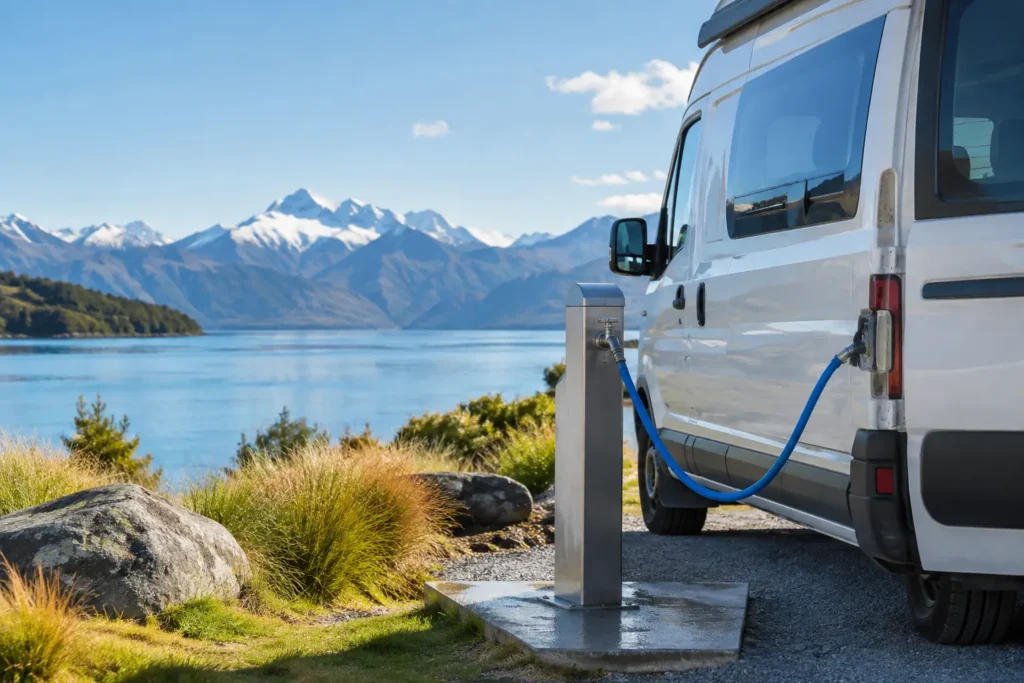
A nearly empty fresh-water tank has a way of showing up at the wrong time: after a long beach walk, halfway through dinner, or parked somewhere beautiful with no tap in sight. Knowing where to refill campervan water is one of those small road-trip skills that makes South Island travel far easier.
The good news is that you do not need to plan every refill down to the liter. New Zealand is well set up for self-contained travel, especially around established towns, holiday parks, and major driving routes. A little forward thinking is enough to keep water simple rather than turning it into a daily mission.
The best places to refill campervan water
For most trips, holiday parks and campgrounds are the most dependable option. They have potable water taps, clear facilities, and someone nearby if you are unsure which tap is safe to use. If you are staying overnight, topping up before you leave in the morning is the easy move. Even if your tank is not empty, starting the day full gives you more freedom to stop wherever the drive takes you.
Public dump stations are another common place to find fresh water. Many New Zealand dump stations have a separate drinking-water tap, but do not assume every tap is potable. The tap used for toilet cassette rinsing is not the one you want for your fresh-water tank. Look for clear signs saying “drinking water” or “potable water,” and if there is any doubt, ask locally or skip it.
Gas stations can help in a pinch, particularly in larger towns, though they are not guaranteed to have a public water tap. Always ask the staff first. A quick, polite question goes a long way, and it is better than attaching a hose where it is not intended for drinking water.
Some visitor centers, public parks, boat ramps, and community facilities also have taps. These are less consistent, and the water may not always be marked as suitable for drinking. Treat them as a backup rather than the foundation of your plan.
Where to refill campervan water on a South Island route
The South Island is made for road trips, but distances between services can be bigger than they look on a map. Refill when you are in a proper town, not when your tank is already low and you are heading toward a remote valley or mountain pass.
Around Christchurch, it is easy to begin with a full tank. Before leaving the city, make sure you have enough water for a few days of cooking, washing up, brushing teeth, and basic cleanup. If your route heads toward Lake Tekapo, Mount Cook, or the Mackenzie Country, topping up in towns such as Geraldine, Fairlie, or Twizel is sensible. These areas are popular, but the scenery quickly gets bigger than the services.
On the West Coast, refill whenever you stay at a campground or pass through a larger settlement. The drive between Hokitika, Franz Josef, Fox Glacier, and Haast is spectacular, but you should not rely on finding a convenient potable tap at every scenic stop. The same applies to inland routes through Arthur’s Pass or toward Aoraki/Mount Cook.
In the lower South Island, Queenstown and Wanaka have plenty of traveler infrastructure. That does not mean you should wait until the tank is empty. Busy areas can make facilities less convenient at peak times, and a five-minute refill before leaving town is easier than changing plans later.
The Catlins, Central Otago, and the roads toward Milford Sound reward travelers who stay flexible. They also reward travelers who leave town prepared. Fill up before heading into more remote areas, especially if you plan to camp away from a holiday park for a night or two.
How much water should you carry?
It depends on your van, your travel style, and whether you are staying at campgrounds regularly. A compact campervan has limited storage, and water is heavy – one liter weighs about 2.2 pounds. There is no prize for carrying a full tank every single day if you are driving a lot and passing through towns.
For two people, a useful rule is to top up every one to three days. If you are mostly using campground kitchens and showers, your tank will last longer. If you are cooking every meal in the van, washing dishes often, or camping remotely, refill more frequently.
Fresh water in a campervan is best used for drinking, cooking, teeth brushing, hand washing, and dishes. It is not a long-shower supply. Keeping water use practical means less weight in the van and fewer stops built around finding a tap.
Use the right tap, hose, and habits
The cleanest water source can still become a problem if the equipment is not clean. Keep your drinking-water hose separate from anything used near the toilet cassette or wastewater area. Store it in a clean bag or container, and keep the ends off the ground when possible.
Before filling, take a look at the tap and the surrounding area. A clean, clearly marked potable-water tap is what you are after. If a hose is already attached and looks questionable, use your own if you have one. If the tap has no signage and sits beside a dump-point rinse hose, do not gamble on it.
A few easy habits make a difference:
- Refill at campgrounds or marked potable-water stations whenever possible.
- Keep your fresh-water hose clean and separate from dump-station gear.
- Do not let the hose end touch the ground, drain, or wastewater fittings.
- Fill before remote drives, not after you have run low.
- Empty gray water only at approved disposal points, never into storm drains or onto the ground.
If the water smells odd, looks discolored, or comes from an unmarked source, do not put it in your tank. Buy drinking water for the day and refill properly at the next reliable stop. That is a minor inconvenience compared with contaminating your whole water system.
Do you need to treat campervan water in New Zealand?
Usually, no, when you are filling from a marked potable-water supply. New Zealand’s treated town water is generally suitable for drinking, and most travelers use it without extra treatment. Still, local notices can change after heavy rain, flooding, or maintenance work, particularly in smaller communities.
If a campground or town posts a boil-water notice, follow it. Boiling water is the safest response for drinking, cooking, and brushing teeth. A basic filter can improve taste or catch sediment, but it does not automatically make unsafe water safe. If you prefer extra peace of mind, carry a refillable drinking bottle and a simple treatment option, but do not let gear replace common sense.
Plan refills without overplanning your trip
The best approach is simple: check your water level each morning, refill when you are near an obvious reliable source, and do not leave a town for a remote route with only a few inches in the tank. You do not need a complicated spreadsheet or a van full of spare containers.
It also helps to separate fresh water from wastewater in your mind. A fresh-water refill is about what goes into your body and your meals. Gray-water disposal is about leaving places as clean as you found them. Both matter, and both are part of traveling responsibly in a campervan.
Before you set off each day, look at the road ahead rather than only the next destination. If you are heading into the mountains, along the West Coast, or down a quiet stretch of the Catlins, fill up while the option is right in front of you. Then get back to the good part: driving slowly, stopping often, and enjoying the South Island without a low-water light dictating the day.