
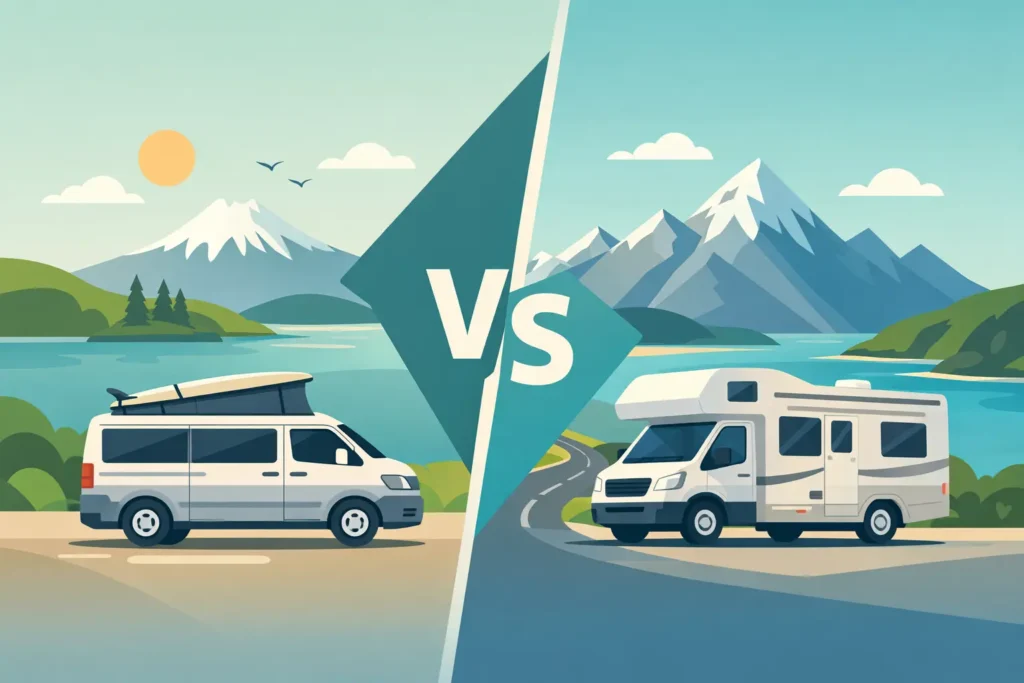
You feel the difference fast on a South Island road. One minute you are pulling into a tiny lakefront spot near Tekapo, the next you are winding through a narrow pass or grabbing groceries in a small town where parking is tight. That is where the campervan vs motorhome NZ question stops being theoretical and starts shaping your whole trip.
If you are deciding between the two, the honest answer is simple: most travelers do not need as much vehicle as they think. A motorhome can make sense for some trips, especially if space is the top priority. But for a lot of couples and independent travelers exploring New Zealand, a compact campervan is the easier, cheaper, and more practical choice.
Campervan vs motorhome NZ: what is the real difference?
In New Zealand, the line can blur because rental companies use the terms loosely. Still, in practical terms, a campervan is usually smaller, easier to drive, and built for simple road-trip living. A motorhome is larger, taller, and more house-like, often with more internal space, more onboard systems, and a bigger footprint in every sense.
That footprint matters. It affects fuel costs, parking, ferry fees, campsite options, and how relaxed you feel behind the wheel. A compact van asks less of you as a driver. A motorhome gives you more room, but you pay for it in money, flexibility, and sometimes stress.
For South Island travel in particular, where days often involve scenic drives, small towns, trailheads, and changing weather, vehicle size is not just a comfort issue. It is a travel-style decision.
Why smaller often works better in New Zealand
New Zealand roads are beautiful, but they are not built like broad American highways. Even popular tourist routes can be narrow, winding, and exposed. Add one-lane bridges, gravel sections, steep pull-offs, and busy holiday traffic, and bigger vehicles start to feel bigger than expected.
A campervan is simply easier to live with day to day. You can park in more places, move through towns with less hassle, and feel more confident on unfamiliar roads. If your trip includes lots of short stops, changing plans, and freedom to explore without overthinking every turn, compact wins more often than not.
This is also why discreet vans appeal to a lot of travelers. They feel less like driving a rental billboard and more like traveling on your own terms. That low-key style suits people who want a practical road trip, not a bulky vehicle that dominates every stop.
When a motorhome makes more sense
There are cases where a motorhome is the right call. If you are traveling as a family, need multiple fixed sleeping areas, or want a full interior setup with more separation between living spaces, extra room can be worth it. The same goes for travelers spending long stretches in bad weather who know they will want to cook, lounge, and move around inside without compromise.
A motorhome can also suit travelers who care less about driving ease and more about having something closer to a mobile apartment. If that is your priority, the trade-off may feel fair.
But it is worth being honest with yourself here. Many people imagine they need a lot of space because they are picturing worst-case scenarios. In reality, if you plan to hike, sightsee, eat outdoors, and spend most of the day exploring, the vehicle is mainly your bed, kitchen, and basecamp. That is a different job from being a full-time indoor living space.
Cost is not just the daily rate
This is where campervan vs motorhome NZ becomes much clearer.
A motorhome usually costs more to rent, but the daily rate is only the start. Bigger vehicles tend to burn more fuel, and over a South Island itinerary that can add up quickly. They may also come with higher insurance costs, larger bond requirements, and extra charges tied to size or equipment.
Then there are the indirect costs. You may end up choosing holiday parks more often because a larger setup is less convenient in tighter spaces. You might skip certain stops because parking is awkward. You may even spend more simply because the vehicle pushes you toward a more structured, less flexible style of travel.
A compact campervan usually keeps the whole trip lighter on the wallet. That matters if you would rather spend money on a glacier flight, a few better meals, or an extra couple of days on the road instead of paying for space you barely use.
Comfort depends on how you travel
A lot of rental marketing treats comfort like a size contest. Bigger bed, bigger fridge, bigger cabin. But comfort on a road trip is not only about square footage.
Real comfort is being able to pull over without stress, set up quickly, sleep well, and keep your days simple. It is having a layout that works without needing a ten-minute tutorial every time you want to make coffee or pack up in the morning.
That is where well-designed compact vans often beat larger vehicles. If the space is thought through properly, a small campervan can feel efficient rather than cramped. Good storage, a usable bed, and straightforward gear matter more than extra bulk.
This is also why hand-built vans can appeal to experienced travelers. They are often designed around actual road use, not showroom impressions. At Kim Campers, that practical approach is the whole point – no unnecessary complexity, just what works for a South Island trip.
Driving confidence changes the trip
People often underestimate how much driving comfort affects enjoyment. If you are nervous about corners, worried about clearance, or constantly looking for oversized parking, that tension follows you all day.
In a campervan, especially a compact one, the driving experience is usually far closer to a standard vehicle. That means less fatigue, easier reversing, and more confidence on routes that would feel intimidating in a large motorhome.
This matters even more if only one person in your group is willing to drive. A van that both travelers can handle comfortably gives you more freedom and less pressure. That can be the difference between a relaxed trip and one person doing all the hard work.
Camping freedom and self-contained travel
Both campervans and motorhomes can be set up for self-contained travel, so this is not automatically a win for the larger vehicle. What matters more is whether the setup is compliant, practical, and suited to how you plan to camp.
For many travelers, a compact self-contained campervan hits the sweet spot. You get the flexibility that makes van travel in New Zealand so appealing, without carrying around excess size. You can move more easily between towns, scenic reserves, and overnight spots while still having the basics covered.
The key is not chasing the biggest onboard setup. It is choosing something that supports the kind of trip you actually want to have.
So which one should you book?
If you are a couple, solo traveler, or two friends doing a South Island road trip, a campervan is often the better fit. It is easier on narrow roads, easier to park, cheaper to run, and better suited to travelers who want freedom without fuss.
If you are traveling with a larger group, want more indoor living space, or know that house-like comfort matters more to you than mobility, a motorhome may be worth the extra cost and size.
The best choice is not the most impressive vehicle on paper. It is the one that matches the way you move. For a lot of New Zealand trips, that means keeping it simple.
A good road trip vehicle should make the country feel more open, not more complicated. Pick the setup that lets you turn down the side road, stop at the small beach, and park without a debate. That is usually where the best parts of the trip begin.