
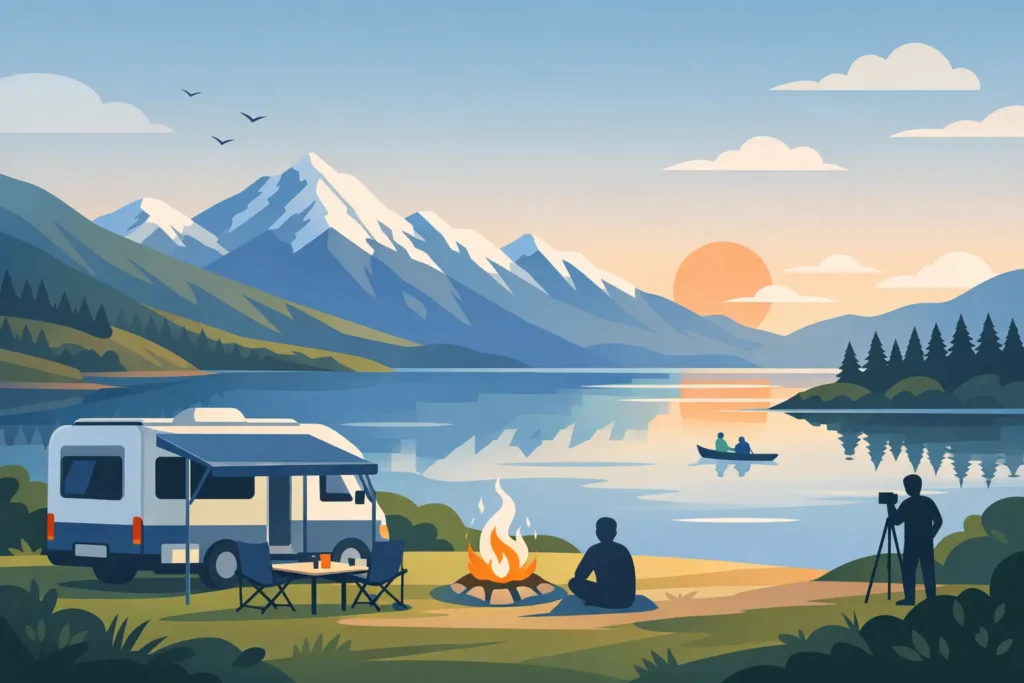
You do not really understand the South Island until you wake up beside a cold lake, boil water with numb fingers, and watch the first light hit the mountains before the road gets busy. That is the appeal of south island freedom camping. It is cheaper than holiday parks, more flexible than fixed bookings, and often the best way to stay close to the places you actually came to see.
It is also easy to get wrong.
A lot of travelers arrive thinking freedom camping means you can pull over anywhere, sleep for the night, and move on in the morning. New Zealand does not work like that. On the South Island especially, the difference between a smooth trip and an expensive, frustrating one usually comes down to understanding where you can stay, what kind of vehicle you need, and how much effort you put into being low impact.
What south island freedom camping really means
Freedom camping usually means staying overnight on public land or in designated areas outside paid campgrounds. Sometimes that means a scenic gravel lot by a river. Sometimes it means a basic parking area with clear rules and a strict one-night limit. Sometimes it means no overnight stays at all, even if the view looks perfect and there is nobody around.
The biggest mistake is assuming remote equals legal. A quiet beach access road or empty lakeside parking area might still be managed by a local council with a no-overnight policy. Signs matter. Council rules matter. Vehicle requirements matter too.
In practical terms, south island freedom camping works best when you treat it as a system, not a free-for-all. You plan a rough route, check local restrictions, arrive with enough water and power to be self-sufficient, and leave the spot exactly as you found it.
Why the South Island suits this style of travel
The South Island is built for road trips. Distances are manageable, scenery changes fast, and some of the best places are far better experienced early in the morning or late in the evening when day-trippers have gone. Staying closer to trailheads, lakes, and small towns gives you more time on the trip and less time backtracking from standard accommodations.
It also gives you flexibility when weather shifts. That matters more than people expect. A wet forecast in Mount Cook might push you toward Central Otago. Strong winds on the West Coast might make you head inland. If every night is pre-booked, adapting gets expensive. If your van is set up properly and you understand the rules, you can make smarter calls day by day.
There is a budget angle too. Paid campgrounds add up quickly, especially on a multi-week trip. Freedom camping will not replace every campground night, and it should not. Sometimes you will want a proper shower, laundry, and a powered site. But mixing in legal freedom camping can make a South Island trip much more affordable without making it feel cheap.
The van matters more than the view
A beautiful campsite does not help much if your setup is awkward, obvious, or not legal for the places you want to stay. This is where smaller, practical campervans tend to make more sense than many first-time visitors realize.
On South Island roads, compact is useful. You will deal with tight town parking, gravel pull-ins, narrow scenic roads, and the occasional windy stretch where driving something oversized stops being fun. A simpler self-contained van is often the sweet spot. You get the ability to stay in more places while keeping fuel, handling, and daily setup manageable.
Just as important, discreet vans attract less attention. That does not mean hiding or bending rules. It means traveling in a vehicle that feels normal on the road and in small towns, rather than announcing itself like a rolling billboard. For independent travelers who want a quieter, more local-feeling trip, that difference is real.
Rules that catch people out
Some freedom camping areas allow only certified self-contained vehicles. Some allow any vehicle in a specific marked area. Some have time limits such as one or two nights. Others ban overnight parking entirely. These rules change by district, so what worked near Queenstown may not apply in Canterbury or on the West Coast.
The safest approach is simple. Read the signs when you arrive, not just what you saw online three days earlier. If a spot looks ambiguous, assume that ambiguity is your problem, not a loophole. Rangers and councils are not usually interested in debates at 9 p.m. about what you thought a rule meant.
You should also expect popular places to fill early in peak season. A legal freedom camping area with ten spaces is not really an option if you arrive after dark and all ten are full. Build some margin into your day. Have a backup paid campground in mind. Good road trips are flexible, but they are not careless.
How to freedom camp without acting like a tourist stereotype
Most of the tension around freedom camping comes from a small number of people leaving trash, dumping waste, blocking access, or treating public land like a private backyard. If you want this style of travel to keep working, the standard is pretty basic: be easy to ignore.
Arrive quietly, park neatly, and do not spread out beyond your vehicle. Keep chairs, cooking gear, and general campsite sprawl to a minimum unless the location clearly allows that kind of use. Do not leave toilet paper in bushes. Do not empty wastewater where it does not belong. Do not play music for the whole lake to hear.
It sounds obvious, but this is what separates a good overnight stop from the kind of behavior that gets places restricted. Freedom camping is not just about what you can get away with. It is about proving that travelers can use shared spaces without wrecking them.
Best kinds of stops for south island freedom camping
Not every night needs to be dramatic. Some of the best stops are useful rather than famous – places near a trailhead, just outside a town, or along the route to an early morning activity. Chasing only postcard spots can make a trip more stressful than it needs to be.
A smart mix usually works better. Use simple overnight areas for transit days, then save the more scenic stays for places where you want to slow down. Lakeside and coastal spots are obvious favorites, but inland reserves, riverside pull-ins, and small-town designated areas can be just as valuable if they position you well for the next day.
The South Island rewards early starts. If your campsite lets you make coffee and be on the trail before the buses arrive, that is often worth more than the most photogenic parking spot on the map.
When paid campgrounds are the better call
There is no prize for avoiding holiday parks at all costs. After a few days on the road, a hot shower, proper kitchen space, laundry, and a legal place to reset can be the smartest money you spend.
This is especially true in bad weather, during peak travel periods, or when you need to recharge yourself as much as the van. If a town has limited legal overnight options and you are arriving late, paying for certainty is often better than driving around in the dark hoping something opens up.
A balanced trip usually feels better than a purist one. Mix freedom camping with campground stays and you get the savings, flexibility, and scenery without turning every evening into a search mission.
Planning a better route from Christchurch or Queenstown
If you are starting in Christchurch, freedom camping gets easier when you think in loops rather than long jumps. Canterbury, the Mackenzie Basin, the West Coast, and the top of the island all offer very different rhythms, and trying to rush through all of them usually means more driving and worse campsite timing.
If you are starting in Queenstown, things can feel busier because the area is so popular. That does not mean it is a bad launch point. It just means you want to stay ahead of the crowd, avoid arriving late to known hotspots, and be realistic about how much ground you can cover in one day.
This is where a smaller, straightforward rental setup helps. With a simple van and direct support, you spend less time figuring out systems and more time adjusting the route around weather, energy, and the places that actually deserve another night. That is a big part of the appeal behind a traveler-built rental business like Kim Campers.
What makes a freedom camping trip feel easy
Usually, it is not one big thing. It is having enough battery for a cold night. Keeping your setup simple enough that moving on in the morning takes ten minutes, not forty-five. Choosing a van you are comfortable driving into town, onto a gravel shoulder, and through a windy pass. Knowing when to stop searching and book a proper campground.
The South Island gives you a lot if you travel with a bit of common sense. Respect the rules, keep your footprint small, and leave room in your plan for weather and chance. Then the good parts show up naturally – the quiet lake, the empty morning road, the stop you had not planned that ends up being the one you remember most.
If you approach south island freedom camping that way, it stops feeling like a budget workaround and starts feeling like the whole point of the trip.