
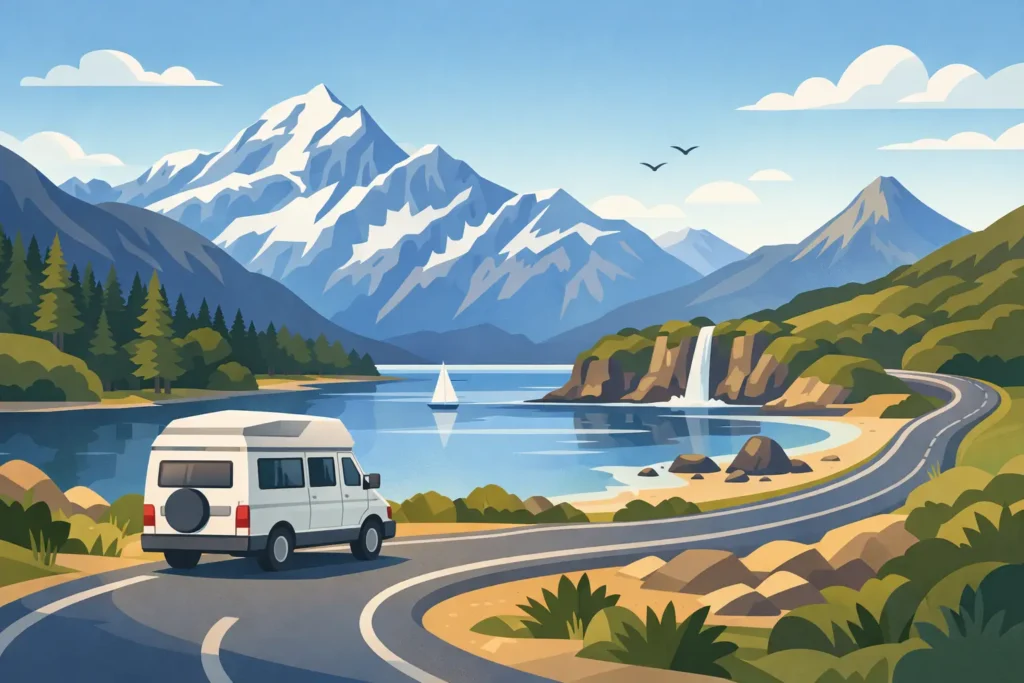
The South Island is not a place to rush through. A route that looks like three hours on a map can turn into a full day once you stop for a lake swim, a short track, a bakery pie, and the kind of viewpoint that makes you pull over without thinking. The best campervan routes South Island travelers choose leave room for that. They connect big scenery with practical driving days, decent places to sleep, and enough flexibility to follow good weather.
A compact campervan suits this island well. You can fit into ordinary parking spaces, handle small-town grocery runs without fuss, and get down roads where a large motorhome feels like work. Start in Christchurch if you want an easy loop through the center and north, or begin around Queenstown if alpine scenery is the priority.
1. Christchurch to Lake Tekapo and Aoraki/Mount Cook
This is one of the best first routes after picking up a campervan in Christchurch. Head inland across the Canterbury Plains, stop in Geraldine for supplies or coffee, then follow the turquoise water of Lake Tekapo toward Aoraki/Mount Cook National Park.
Plan two to three nights. Tekapo is good for stargazing and an evening walk by the lake, while Mount Cook Village is where the landscape gets properly dramatic. The Hooker Valley Track is a popular choice because it delivers big mountain views without requiring technical hiking experience.
The trade-off is popularity. In peak season, campgrounds and parking areas fill early, and the weather can change quickly around Mount Cook. Book paid campgrounds ahead when you can, carry food before reaching the village, and treat the drive beyond Tekapo as part of the day rather than a transfer to get over with.
2. Tekapo to Wānaka via Lindis Pass
For a satisfying inland crossing, continue south from Tekapo through Twizel and Omarama, then over Lindis Pass to Wānaka. It is roughly a four-hour drive without stops, but it deserves a full day. The road moves from Mackenzie Country lakes into dry golden hills, then drops toward Central Otago.
Wānaka works well as a two-night stop. It has supermarkets, places to eat, lakefront space to slow down, and easy access to walks ranging from a casual shoreline stroll to a serious climb. If the forecast is clear, Roys Peak is famous for a reason, but start very early and be ready for a steep, exposed day.
Lindis Pass can be cold, windy, or icy in winter. Check road conditions before setting out, especially if your trip falls between June and September. In summer, carry water and do not underestimate the sun on exposed trails.
3. Wānaka to Queenstown via Cardrona
The drive from Wānaka to Queenstown is short enough to feel easy, but Cardrona makes it memorable. The route rises quickly into the hills, with wide views behind you and a descent into the Wakatipu Basin ahead. It is a better option than simply racing around the main highway if you want the road trip to feel like part of the experience.
Give yourself half a day even though the distance is modest. Stop in Cardrona, take photos at the summit, then arrive in Queenstown with time to park up and walk along the waterfront. The road is sealed but winding, and conditions are more demanding after snow or heavy rain.
Queenstown is energetic, scenic, and useful for restocking. It is also expensive and busy. A night or two makes sense if you want activities, restaurants, or a break from driving. If you prefer quieter lakeside evenings, keep moving toward Glenorchy or the southern lakes.
4. Queenstown to Glenorchy and Kinloch
This is a short out-and-back route, but it is one of the South Island’s strongest scenic drives. The road hugs Lake Wakatipu beneath steep mountains, with plenty of places to stop without committing to an all-day mission. Glenorchy has a small-town feel that comes as a relief after Queenstown’s pace.
Stay one or two nights if you can. The area is a base for walks, horse trekking, kayaking, and simply doing less. Continue toward Kinloch for a quieter corner of the lake, but keep an eye on fuel and supplies. This is not a route for rushing in late, taking one photo, and turning around.
The main limitation is that you return the same way. That is not a problem here. Light and weather change the whole look of the lake, so the drive back rarely feels repeated.
5. Queenstown to Te Anau and Milford Sound
If you only make one proper detour from Queenstown, make it Milford Sound. Drive south through Kingston and around the edge of Lake Wakatipu, then continue through Te Anau to Milford. The full return trip is long, so the sensible way to do it is with at least one night in Te Anau and an early start for Milford Road.
The road is spectacular but needs patience. There are waterfalls, short walks, mirror lakes, and mountain views that can easily stretch the drive. Do not rely on the posted travel time, and never plan to arrive for a cruise or tour with minutes to spare.
Milford Road has avalanche zones, one-way sections, and winter closures or restrictions at times. Check conditions on the morning you leave. Fuel up in Te Anau, download anything you need before heading west, and respect no-stopping areas. The scenery is huge, but this is still a mountain road, not a theme park ride.
6. Te Anau to the Catlins Coast
For travelers who want quieter roads and fewer crowds, head from Te Anau through Invercargill and into the Catlins. This stretch trades alpine drama for windswept beaches, native forest, waterfalls, and the chance of seeing sea lions or penguins from a respectful distance.
Allow two or three nights between Curio Bay, Pūrākaunui Falls, Nugget Point, and the small coastal towns along the way. Distances are not huge, but roads are slow and there is no reason to hurry. The Catlins rewards an unplanned stop more than a tightly scheduled itinerary.
Facilities are thinner here than around Queenstown or Wānaka. Fill up with gas, keep groceries topped up, and use designated campgrounds or legal overnight options. Mobile coverage can be patchy, which is either inconvenient or exactly why you came.
7. Dunedin to Oamaru via the Otago Coast
The Otago coast is a good route for wildlife, food, and a more lived-in version of the South Island. Start in Dunedin, where the peninsula offers coastal views and wildlife experiences, then travel north through Moeraki to Oamaru.
One or two nights is enough, though it depends on how much time you want to spend walking beaches and watching wildlife. Moeraki Boulders are worth seeing early or late in the day, when the beach is quieter. Oamaru has a distinctive historic district, good food options, and an easygoing overnight feel.
Keep your distance from wildlife and follow local signs. Seeing a sea lion on a beach is memorable, but it is not an invitation to get closer for a photo. This route is simple to drive and works particularly well for couples who want a gentler finish before returning to Christchurch.
8. Christchurch to Kaikōura and Hanmer Springs
North of Christchurch, Kaikōura gives you a rare mix of mountains and ocean in the same frame. The coastal drive is scenic, Kaikōura itself is compact, and whale watching, seafood, and shoreline walks make it an easy two-night stop. From there, loop inland to Hanmer Springs for hot pools and a change of pace before returning to Christchurch.
This route is a practical choice for a shorter trip, especially if you have five to seven days rather than two weeks. The drive inland from Kaikōura is quieter and more rural, while Hanmer provides a comfortable reset before the final day back to the city.
Build the route around your actual days
The best route is not necessarily the longest one. With a week, choose one region and leave space for weather changes. With 10 to 14 days, a Christchurch to Tekapo, Wānaka, Queenstown, Te Anau, Catlins, Dunedin, and Christchurch loop is realistic if you avoid stacking too many long driving days.
Plan overnight stops before you lose signal, understand the local freedom camping rules, and use approved sites where required. A self-contained van gives you more options, not permission to park anywhere. Small habits make the trip better: refill water when you can, buy groceries before remote areas, and reach your overnight stop before dark when possible.
Kim Campers was built for this kind of travel: simple, discreet, and comfortable enough to stay out a little longer when a place feels right. Leave room in the plan for the roads you did not expect to love. Those are usually the ones you remember.