
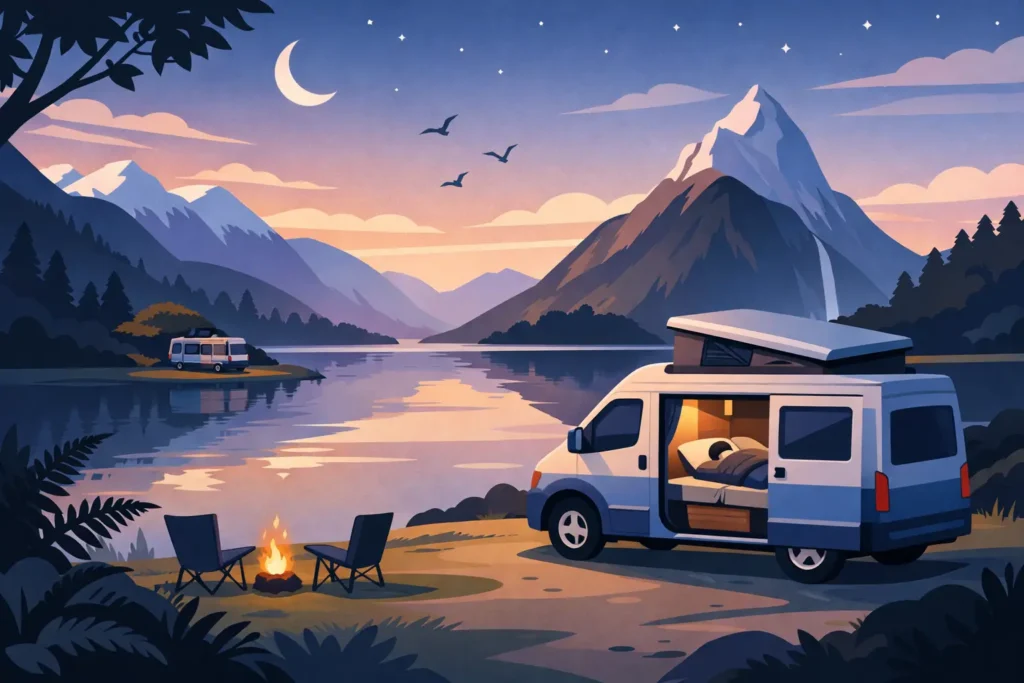
A great South Island day can end at a lake with no phone signal, a windswept beach, or a tiny township where the bakery opens before sunrise. Finding the best places to sleep in a campervan is what turns that freedom into a good night’s rest – without a knock on the window, a parking fine, or a long drive after dark.
There is no single perfect overnight option. A DOC campsite might give you the best location, a holiday park might give you the best shower, and a freedom camping area might be useful when you need a simple stop near town. The smart move is knowing what each option is for, then choosing the one that fits the day you actually had.
The best places to sleep in a campervan in NZ
For most South Island road trips, overnight stops fall into four practical categories: DOC campsites, holiday parks, designated freedom camping areas, and paid private campgrounds. Each has a place on the route.
DOC campsites for the scenery
Department of Conservation campsites are often where the South Island feels most like the South Island. They can be beside rivers, near trailheads, tucked into native bush, or set along a quiet stretch of coast. Many are basic: expect a toilet, water that may need treating, and little else. Some have booking requirements, especially during the busy summer period.
These sites are ideal when the location matters more than facilities. After a hike in Mount Cook, a day around the Catlins, or a long drive through the West Coast, a basic campground can be exactly right. Bring enough drinking water, charge your devices while driving, and do not assume there will be a kitchen, hot shower, or cell service.
DOC sites range from very simple to fairly well equipped, and fees vary. Check the current campsite details before you arrive, not when you are already low on fuel and daylight. In peak season, popular spots can fill up.
Holiday parks when you need a reset
Holiday parks are not always the most dramatic place to park, but they can save a trip from becoming uncomfortable. A proper shower, laundry, kitchen, powered site, Wi-Fi, and a place to charge everything can feel very good after several nights on the road.
They are especially useful in larger towns and before or after activities with an early start. Think Christchurch at the beginning or end of a trip, Queenstown when you want to leave the van parked and walk into town, or Te Anau before heading toward Milford Sound. They also make sense during wet weather, when drying clothes and cooking under cover becomes more valuable than a remote view.
The trade-off is cost and atmosphere. Holiday parks are usually busier, closer to roads or town centers, and less private. Use them intentionally rather than treating every night as the same.
Designated freedom camping areas for simple overnights
Freedom camping can be a useful part of a South Island itinerary, but it is not a free pass to sleep anywhere. Local councils set their own rules, and restrictions can change by area, season, and vehicle type. Some places allow overnight stays only in clearly marked zones. Others prohibit camping entirely, even if the parking lot looks quiet.
A legal freedom camping area is usually best for a one-night stop when you are self-contained, tidy, and not looking for facilities. These areas can be convenient near towns, beaches, and main travel routes, but they are often popular. Arriving late may mean a crowded lot, traffic noise, or no space at all.
Read signs carefully when you arrive. A sign that permits daytime parking does not necessarily allow overnight camping. If the rules are unclear, choose a campground instead. It is cheaper than a fine and better for the places everyone came to enjoy.
Private campgrounds and farm stays for a quieter stop
Small private campgrounds can be a good middle ground. They may offer more space and character than a holiday park, with enough facilities to make life easy. Some are on farms, vineyards, or quiet rural properties, which can make them feel like part of the journey rather than just a place to sleep.
Availability varies, so these stops work best when you have a loose plan rather than a strict schedule. They are particularly helpful in regions where public camping is limited or where you would rather avoid busy town campgrounds.
How to choose where to stop tonight
The best overnight spot is usually decided by four things: your energy level, tomorrow’s plan, the weather, and what your campervan needs.
If you have been driving for five hours and it is getting dark, do not push another hour just to reach a famous lake. Find a legal, easy place nearby and enjoy the lake in the morning. South Island roads are slower than they look on a map, with one-lane bridges, winding sections, photo stops, and weather that can change quickly.
If tomorrow starts early, sleep close to the activity. Staying in Te Anau before Milford Sound, near Aoraki/Mount Cook before a morning walk, or close to a trailhead before a big hike gives you more time and less stress. If rain is forecast, choose somewhere with a covered kitchen, drying room, or at least enough space to sit comfortably inside the van.
Also think about water, toilets, trash, and battery power. A compact campervan is easy to drive and park, but it works best when you stay on top of the basics. Empty waste where you are meant to, refill water before it becomes urgent, and do not rely on a remote campground to have every service you need.
Places that look tempting but usually are not worth it
A quiet roadside pullout, a supermarket parking lot, or a scenic lookout can look like an easy overnight answer. Often, it is not. These places may be restricted, poorly lit, exposed to traffic, or regularly checked. Even where overnight parking is not explicitly banned, sleeping there can create problems for local residents and businesses.
The same goes for narrow roads near popular attractions. Parking in the wrong spot can block access for emergency vehicles, buses, farm traffic, or other travelers. If a place is beautiful enough to attract everyone, it probably needs careful parking rules to stay that way.
Avoid arriving at isolated sites after dark if you have never been there before. Finding the toilet, leveling the van, checking the ground, and working out where you are allowed to park is easier in daylight. A simple rule: aim to be parked before sunset whenever you can.
A practical overnight routine
A little routine makes campervan travel feel easy. Before dinner, decide whether you are staying put. Park level if possible, set up the bed, fill your water bottle, and check that your doors are locked. Keep your keys, phone, headlamp, and a warm layer within reach.
Cook early if the weather is good. South Island evenings can get cold quickly, even after a warm day, and coastal wind has a way of making a simple meal feel complicated. Keep your campsite clean and pack all food away. Kea are clever, other wildlife should stay wild, and nobody wants to wake up to a mess.
In the morning, leave the site better than you found it. Take every piece of trash, use proper dump stations, and keep noise low around other campers. This is not about being precious. It is how freedom camping and low-cost public campgrounds remain available for the next travelers.
Plan less, check more
You do not need to book every night of a South Island road trip. In fact, leaving room to change plans is one of the best reasons to travel by campervan. But flexibility works best when it is backed by a quick daily check of campsite availability, road conditions, weather, and local camping rules.
During Christmas through February, long weekends, school holidays, and major events, book popular areas ahead. Around quieter regions and shoulder season, you can often decide later in the day. Keep a backup option in mind, especially near Queenstown, Wānaka, Tekapo, Milford Sound, and the West Coast in summer.
A simple, self-contained van gives you choices, not permission to ignore the rules. That is the good version of campervan travel: park legally, sleep well, wake up somewhere worth seeing, and leave enough of the place behind for the next person to enjoy it too.