
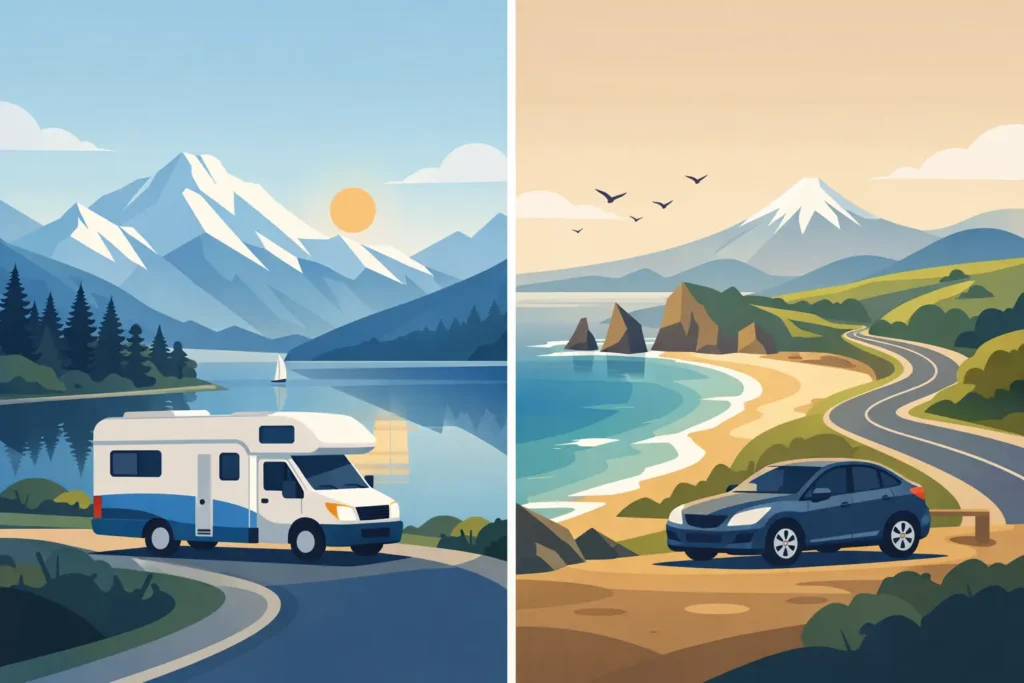
Landing in Christchurch with a loose plan, a weather app, and a week or two to explore the South Island sounds simple enough – until you have to choose your setup. The real question is usually this: campervan or car roadtrip? That choice affects where you sleep, how much you spend, how flexible your route feels, and whether your trip runs smoothly or turns into a constant cycle of packing, checking in, and looking for bathrooms.
For some travelers, a car is the right call. For others, a compact campervan makes the whole trip easier. The best option depends less on travel style in theory and more on how you actually want your days to work.
Campervan or car roadtrip: what changes day to day?
On paper, both options get you to the same places. You can drive from Christchurch to Lake Tekapo, down the coast, over to Wanaka, or into Fiordland either way. But the daily rhythm is completely different.
With a car road trip, you are separating transport from accommodation. That means more fixed points in the day. You drive, arrive somewhere by check-in time, unload your bags, and then repeat the process the next morning. If you are moving often, that routine can start to eat into the trip.
With a campervan, transport and accommodation are combined. You still need a plan, especially in peak season, but your day has more room in it. If a beach is empty, the weather turns good, or you want to stay longer by a lake, it is easier to adapt. You are carrying your setup with you rather than rebuilding it every night.
That freedom matters more in the South Island than people expect. Distances are manageable, but conditions change quickly. A place that looks average in the morning can turn stunning by sunset. A route that felt like a quick stop can become the highlight of the week.
Cost is not as simple as it looks
A lot of travelers assume a car road trip is always cheaper. Sometimes it is. Sometimes it really is not.
If you rent a car and book private rooms, hotels, or cabins every night, the budget can climb fast, especially in popular places like Queenstown, Wanaka, and Tekapo. Even if the car rental itself looks affordable, your nightly accommodation costs keep stacking up.
A campervan usually has a higher daily rental price than a small car, but it covers more of the trip in one cost. You are not just paying for wheels. You are paying for transport, a bed, basic living space, and a more flexible travel setup. If you are traveling as a couple, that math often starts to make sense pretty quickly.
The other cost people miss is food. In a car, you are more likely to rely on cafes, takeout, or restaurant meals because your setup for storing and preparing food is limited. In a campervan, even a simple kitchen arrangement can save real money over a week or two. It also helps in smaller towns where dining options are limited or close early.
That said, if you are doing a short trip, staying mostly in one place, or already have cheap accommodation lined up, a car can still be the lower-cost option. It depends on how often you move and how independently you want to travel.
Comfort means more than seat quality
When people compare a campervan and a car, they often think about driving first. Fair enough. New Zealand roads are scenic, but they are not all easy. There are narrow sections, changing weather, and plenty of winding roads. A regular car can feel less intimidating, especially if you are not used to driving on the left.
But driving comfort is only one part of the picture. Trip comfort is broader than that.
In a car, bad weather can make the whole day feel smaller. If it is raining, windy, or cold, you do not have much usable space outside of the front seats until you reach your accommodation. In a campervan, you have somewhere to regroup, make coffee, sort your gear, or wait out a shower without feeling stuck.
There is also the basic comfort of not living out of a suitcase. On a car road trip, luggage often ends up spread across the trunk and back seat, and every stop becomes a small unpacking job. In a well-designed compact campervan, your things can stay in place. That makes the trip feel calmer, especially after a few days on the road.
A campervan is not automatically better
This is where the answer gets more honest. A campervan is not the best choice for every traveler.
If your plan is built around city stays, restaurant dinners, and booked accommodations with private bathrooms every night, a car may fit better. If you only have three or four days and want to move fast, a car plus motels can be simple and efficient. If you are nervous about driving anything larger than a sedan, that matters too.
There are also travelers who just do not want to think about campground routines, water, power, or basic van systems. Even a straightforward campervan asks for a little more involvement than a car. Not much, but some. You are part driver, part passenger, part road-trip operator.
On the other hand, if you value flexibility, dislike rigid check-in schedules, and want your trip to feel less packaged, a campervan starts pulling ahead. It especially suits couples and independent travelers who want to wake up closer to where they actually came to be.
Campervan or car roadtrip for the South Island
The South Island is one of those places where the journey is not filler between destinations. A lot of the best moments happen between towns – at a pull-off you did not plan for, on a quiet stretch of coast, or at a campsite with a better view than the hotel you almost booked.
That is a strong argument for a campervan, but not because bigger is better. In fact, oversized motorhomes can create their own problems. They are more expensive, less discreet, and often more stressful on narrow roads or in small towns.
A compact campervan tends to make more sense here. It gives you the advantages of van travel without the bulk. Easier parking, simpler driving, and a setup that feels practical instead of overbuilt. That middle ground is what many travelers are actually looking for, even if they do not realize it at first.
This is also why small, traveler-built vans appeal to people who want to keep things simple. You get the essentials you will really use, not a long list of features that sound impressive online but make little difference once you are on the road. Kim Campers is built around that idea: direct, practical, and easy to live with.
Questions to ask before you choose
A better way to decide is to stop asking which option is best in general and ask which one matches your trip.
How often are you changing locations? If the answer is every day or two, a campervan removes a lot of friction.
How fixed is your route? If you want freedom to linger or reroute based on weather, a campervan helps.
What kind of budget are you managing? If accommodation is your biggest cost pressure, a campervan may offer better value.
How do you feel about basic road-life logistics? If you want everything handled for you, a car plus lodging may feel easier.
What matters more to you – efficiency or independence? A car can be efficient. A campervan usually feels more independent.
There is no point choosing van travel if you really want a hotel-based trip. There is also no point booking a car if what you actually want is the freedom to pull up somewhere beautiful and call it home for the night.
The best choice is the one that fits how you travel
A lot of people frame this decision as adventure versus convenience. That is too simplistic. A campervan is not automatically the more adventurous option, and a car is not automatically the easier one. Once you factor in moving bags, check-in times, meal costs, and day-to-day flexibility, the balance can shift fast.
For the South Island, many travelers find that a compact campervan hits the sweet spot. It keeps the trip simple, gives you space to breathe, and lets the road decide a little more of the plan. A car still works well for shorter, more fixed trips, especially if you prefer traditional accommodations.
The useful question is not what sounds better before you arrive. It is what will still feel right on day five, when the weather changes, your plans shift, and you want the trip to feel easy rather than managed. Pick the setup that gives you more of that.