
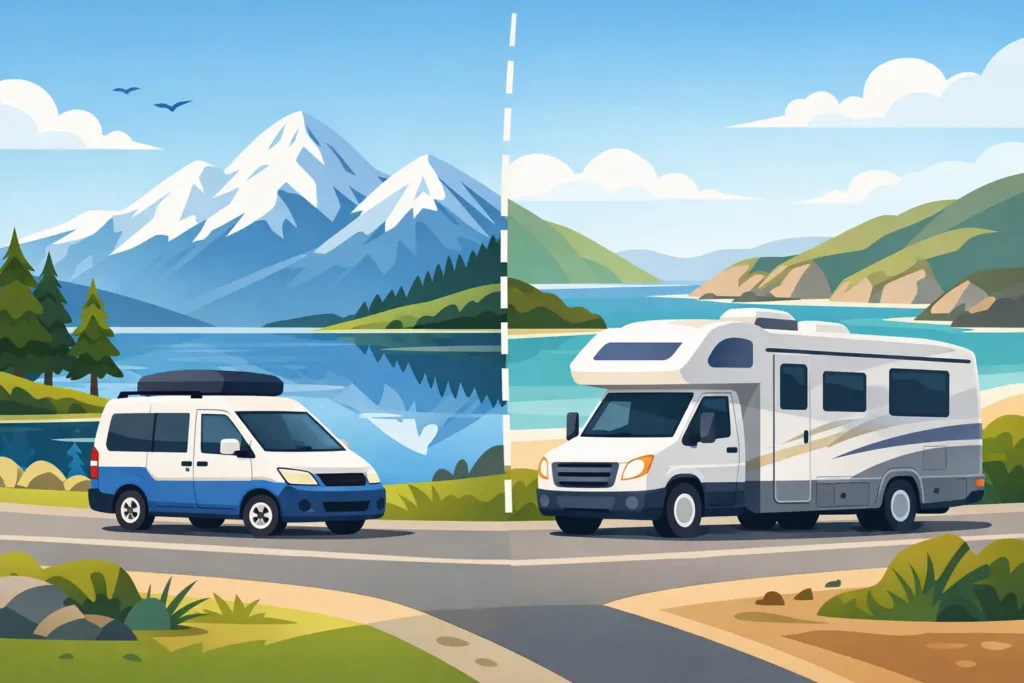
The small campervan versus large RV decision gets real the moment you leave Christchurch and see a narrow mountain road, a busy supermarket parking lot, or a windy lakeside campsite ahead. New Zealand’s South Island rewards travelers who can move easily, stop often, and change plans when the weather does. The biggest vehicle is not automatically the best vehicle.
For most couples and independent travelers, the right choice comes down to how you want to spend your days. Do you want a simple base for hiking, swimming, cooking dinner, and sleeping somewhere beautiful? Or do you need a full indoor living room, separate bathroom, and more space to stay comfortable through several rainy days? Both have a place on the road, but they create very different trips.
Small Campervan Versus Large RV: The Real Difference
A small campervan is built around the essentials. You get a bed, a practical kitchen setup, storage for your gear, and a vehicle that still feels manageable from the driver’s seat. It is a straightforward way to travel for people who expect to spend most of their time outside the van, exploring towns, trails, beaches, and viewpoints.
A large RV gives you more interior room and more household-style features. Depending on the model, that can mean a fixed bathroom, larger fridge, dedicated dining area, more beds, and greater storage capacity. For a family, a group, or travelers who need extra physical space, those things can matter a lot.
The trade-off is simple: more room usually means more vehicle. On the South Island, that affects where you can drive, park, fuel up, and settle in for the night. It can also affect how relaxed you feel when the road gets steep, narrow, or busy.
Driving South Island Roads
The South Island is not one long highway. A road trip can take you from city streets to gravel access roads, single-lane bridges, tight campground entrances, and alpine passes in a matter of days. A compact campervan makes those transitions easier.
Smaller vans are generally less intimidating for drivers who are unfamiliar with New Zealand roads or used to driving on the right. You still need to take your time, watch the conditions, and stay left, but turning into a scenic pullout or finding space outside a bakery feels much more normal in a vehicle closer to a standard van size.
A large RV is absolutely workable on main routes, and plenty of people enjoy traveling that way. Still, it asks for more planning. You may think twice before taking an unsealed side road, pulling into a crowded lookout, or stopping on a whim in a small township. That does not ruin a trip, but it can make it feel more structured.
If your ideal itinerary includes Wanaka, Aoraki/Mount Cook, the Catlins, Arthur’s Pass, and plenty of stops between destinations, easy maneuverability has real value. A small campervan lets you focus less on fitting the vehicle into each place and more on the place itself.
Space Is More Than Square Footage
Large RVs win on indoor space. There is no point pretending otherwise. If you are traveling with children, carrying lots of equipment, or planning a longer trip during colder months, a bigger living area can make daily life easier. Being able to stand up, spread out, and use a bathroom without leaving the vehicle is a genuine comfort.
But more space is not always the same as better travel. Couples on an active South Island trip often use their camper mainly for sleeping, making breakfast, storing food, and getting out of the rain for a short while. In that case, a well-designed compact layout can feel like exactly enough.
The question is whether you need room to live inside or simply a comfortable place to recharge. If hiking, kayaking, sightseeing, and eating outside are the plan, a small campervan usually makes sense. If you expect to spend many hours indoors, especially with more than two people, the extra room of an RV may justify the cost and driving trade-offs.
Costs Beyond the Daily Rental Rate
A larger RV often costs more to rent, but the daily price is only part of the picture. Bigger vehicles generally use more fuel, and longer trips make that difference more noticeable. They can also be harder to park in town, which may lead you to choose paid lots or skip convenient stops.
Campground costs vary, but a large setup can limit your choices at smaller sites. Some places have space for larger motorhomes, while others are better suited to compact vehicles. Booking ahead becomes more useful during busy summer periods when popular holiday parks and campgrounds fill up.
A small campervan can be a practical middle ground for travelers who want the freedom of a self-contained road trip without paying for features they will barely use. Kim Campers, for example, focuses on simple, hand-built vans with the essentials for multi-day South Island travel rather than oversized motorhome living.
Budget is not just about spending less. It is about putting your money toward the parts of the trip you care about. A smaller vehicle may leave more room for a boat trip, a good meal in a small town, an extra night near the mountains, or the flexibility to stay longer when a place feels right.
Campsites, Freedom Camping, and Everyday Practicality
New Zealand has excellent holiday parks, Department of Conservation campgrounds, and designated freedom camping areas. The rules and facilities vary by location, so travelers should always check local signage and stay only where overnight camping is allowed. A self-contained vehicle can expand your options, but it is not a pass to park anywhere.
For campsite life, a compact campervan is often refreshingly simple. You arrive, park, make dinner, and settle in. There is less vehicle to level, less interior to manage, and fewer systems to learn. That simplicity matters after a long drive or a full day on the trail.
Large RVs offer more onboard convenience, particularly when facilities are limited. A private bathroom and larger water capacity can be helpful on a rainy night or when traveling with kids. They also come with more systems, more storage decisions, and sometimes more setup. Travelers who enjoy a full motorhome setup may see that as part of the experience. Others would rather keep things basic.
Who Should Choose a Small Campervan?
A small campervan is usually the better fit for two people who want a flexible, active road trip. It works especially well for first-time New Zealand visitors, solo travelers, couples on a budget, and anyone who wants to drive into towns without feeling like they are piloting a bus.
It is also a strong choice if you like discreet travel. A compact van can feel less conspicuous at a campground or when parked for groceries, coffee, or a quick walk around town. The goal is not to look flashy. It is to have what you need and get on with the trip.
Choose a large RV when your group size, mobility needs, or travel style genuinely requires it. Families who need separate sleeping areas, travelers bringing a lot of gear, and people who place a high priority on indoor comfort may be happier with the extra space. There is nothing wrong with choosing the bigger vehicle when it solves a real problem.
Make the Vehicle Match the Trip
Before booking, picture an ordinary day rather than the highlight reel. Where will you make breakfast? How often will you move? Will you drive into small towns? Are you happy using campground bathrooms? What happens if it rains for a day? Honest answers are more useful than a long list of vehicle features.
For many South Island road trips, the best setup is the one that stays out of the way. A small campervan gives you a bed, a kitchen, and the freedom to follow the weather or take the scenic turnoff without making every stop a logistics exercise. Pick the vehicle that leaves you more energy for the road, the walks, and the places you came all this way to see.