
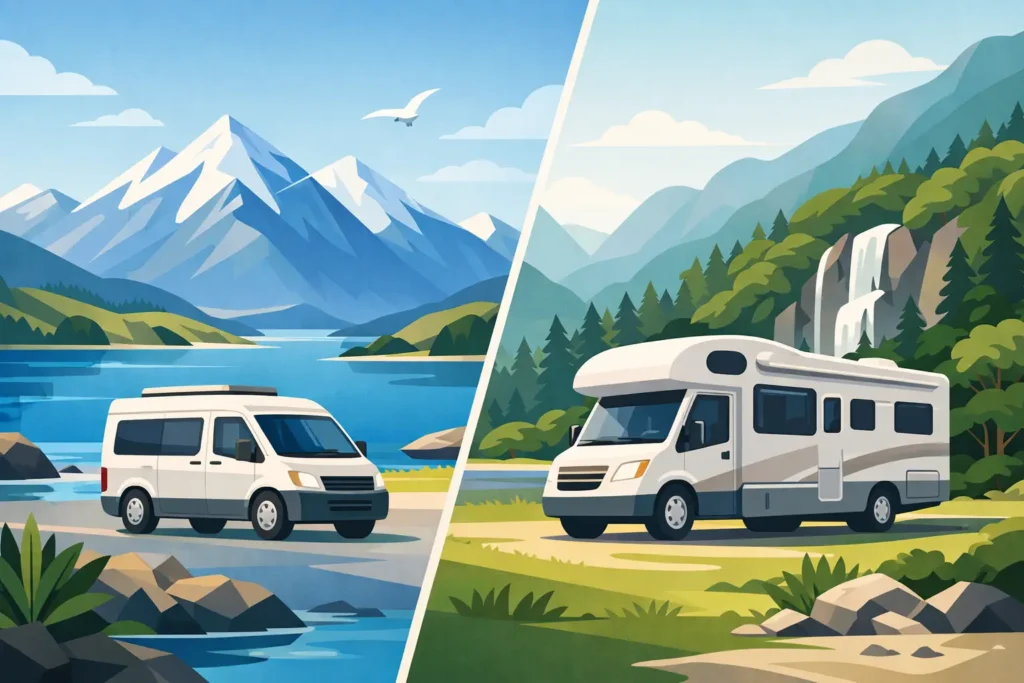
A South Island road trip can look very different depending on what is parked outside your tent-free accommodation each night. Choose the wrong size vehicle and a tight supermarket parking lot, a windy mountain road, or a simple campsite check-in can become more work than it needs to be. If you are deciding between a small van or large motorhome, the best choice is usually less about luxury and more about how you actually want to travel.
For couples and independent travelers, a compact campervan often gives you the freedom people come to New Zealand for in the first place: drive where you want, stop when something catches your eye, and keep the daily routine uncomplicated. A larger motorhome has genuine advantages too, especially when space is the priority. The right answer depends on your route, travel style, budget, and tolerance for managing a bigger vehicle.
Small Van or Large Motorhome: The Real Difference
The obvious difference is size, but size affects nearly every part of a road trip. A large motorhome can feel like a small apartment on wheels. It may offer a fixed bathroom, more standing room, a larger fridge, more storage, and a separate dining area. That can be appealing on a long trip or during a stretch of wet weather.
A small campervan is more stripped back, but that is often its strength. You get a comfortable bed, a practical cooking setup, storage for the essentials, and a vehicle that still feels manageable on normal roads. Rather than carrying a full house around the island, you are carrying what you need for the journey.
South Island travel involves plenty of movement. One day you might be parked near Lake Tekapo, the next walking in Aoraki Mount Cook National Park, then heading through Wanaka or over to the West Coast. For a trip built around scenery, hikes, small towns, and spontaneous stops, a compact vehicle can make the travel days feel easier instead of heavier.
Driving the South Island Is Easier in a Smaller Van
New Zealand roads reward patience, not speed. The South Island has narrow sections, sharp bends, one-lane bridges, steep approaches, and roads that become more dramatic as the views improve. You do not need an oversized vehicle to see the good parts. In fact, a smaller van can make them more accessible.
A compact campervan is easier to park at trailheads, grocery stores, cafes, and lookout points. It is less stressful when you meet oncoming traffic on a narrow road, and it is generally simpler to reverse into a campsite. For visitors arriving from the US, driving on the left already takes some adjustment. Choosing a vehicle that handles more like a regular van keeps that learning curve reasonable.
This matters in places such as Queenstown and Wanaka, where parking can be limited and busy in peak season. It also matters when a weather change forces you to revise your plans. With a smaller vehicle, turning around, finding a new place to stop, or taking an alternate route is usually straightforward.
That does not mean large motorhomes are impossible to drive. Plenty of people enjoy them and travel safely. But they demand more attention. If you are nervous about vehicle size, want to cover a varied route, or plan to drive every few days, smaller is often the more relaxed option.
Your Daily Budget Goes Further With a Compact Campervan
Rental cost is only one part of the comparison. Larger motorhomes commonly cost more per day, use more fuel, and can bring higher costs for insurance, campsite bookings, and extras. The bigger the vehicle, the more you tend to pay to move it, park it, and sleep in it.
A small van keeps the basics under control. It uses less fuel than a large motorhome and usually gives you more options when choosing campsites. If you are traveling for two or three weeks, a modest difference in daily costs can become a meaningful amount of money – money better spent on a boat trip in Milford Sound, a good meal in a small town, or an extra night near a trail you do not want to rush.
There is also a less obvious budget benefit: simple trips have fewer add-ons. A compact, well-designed van does not need a complicated system for every task. You can cook simple meals, sleep comfortably, charge your devices, and keep moving without paying for features you may barely use.
At Kim Campers, the idea is practical rather than flashy: a hand-built van with the essentials for a proper South Island road trip, without the price and bulk of a large rental motorhome.
Comfort Is More Than Interior Space
A large motorhome wins on indoor room. If you are traveling with children, need a fixed bathroom, or expect to spend long periods inside, that extra space may be worth the trade-off. It gives everyone more separation, more storage, and fewer compromises when the weather is poor.
For two people, though, comfort is not only measured in square feet. A comfortable trip also means being able to pull into a viewpoint without worrying about fit, packing up quickly in the morning, and not feeling exhausted after a driving day. It means a bed that is easy to make, gear that has a place, and a kitchen setup that works without a long instruction manual.
Think honestly about your habits. Are you planning to cook elaborate dinners every night? Do you need to work from the road for hours at a time? Are you bringing bulky sporting equipment? A larger vehicle may suit you better.
But if your ideal day starts with coffee by a lake, includes a hike or a swim, and ends with a simple meal at camp, a compact van is usually enough. Most travelers spend their best hours outside anyway.
Campsites, Freedom Camping, and What You Actually Need
New Zealand has a strong camping culture, but it still pays to plan responsibly. Bookable holiday parks are useful for showers, laundry, powered sites, and a reset after a few days on the road. Department of Conservation campgrounds offer beautiful, often more basic places to stay. Rules for freedom camping vary by area and can change, so always check local requirements and use only places where overnight stays are permitted.
Both small vans and large motorhomes can work at campgrounds, provided the vehicle meets the required standards where you plan to stay. The difference is convenience. Small vans fit into more spaces and are easier to position on uneven or compact sites. A large motorhome may need a larger, flatter spot and more room to maneuver.
Do not choose a large vehicle just because you assume you will need it to camp comfortably. South Island campsites often provide the things that take up the most space in a motorhome: bathrooms, kitchens, picnic tables, and communal areas. If you use those facilities, you may find that a simple van gives you all the private space you need.
When a Large Motorhome Makes Sense
There are situations where going bigger is the sensible call. A large motorhome can be the better fit for a family, a group that needs several proper beds, or travelers with mobility needs. It may also suit a winter trip where you expect to spend more time indoors, especially if you prefer having your own bathroom and more room to spread out.
It can work well for travelers who want to stay in one location for several nights at a time rather than drive a fast-moving loop around the island. If your plan is to set up near one region, cook most meals inside, and treat the vehicle as your main accommodation, the extra interior space has real value.
Just go into it knowing what you are trading. You gain room, but lose some flexibility. You gain onboard facilities, but take on more vehicle, more fuel use, and more planning around parking and campsites.
Choose the Vehicle That Leaves Room for the Trip
The best road trip vehicle is not the one with the longest feature list. It is the one that supports the way you want to move through the South Island. For many couples, a small van offers the sweet spot: enough comfort for weeks on the road, enough storage for real travel, and enough agility to enjoy the route without overthinking every stop.
A large motorhome is worth considering when indoor living space is central to your trip. Otherwise, keep it simple. The less time you spend managing your vehicle, the more time you have for the reason you came: early light on the mountains, quiet camp mornings, and the freedom to take the road that looks interesting.